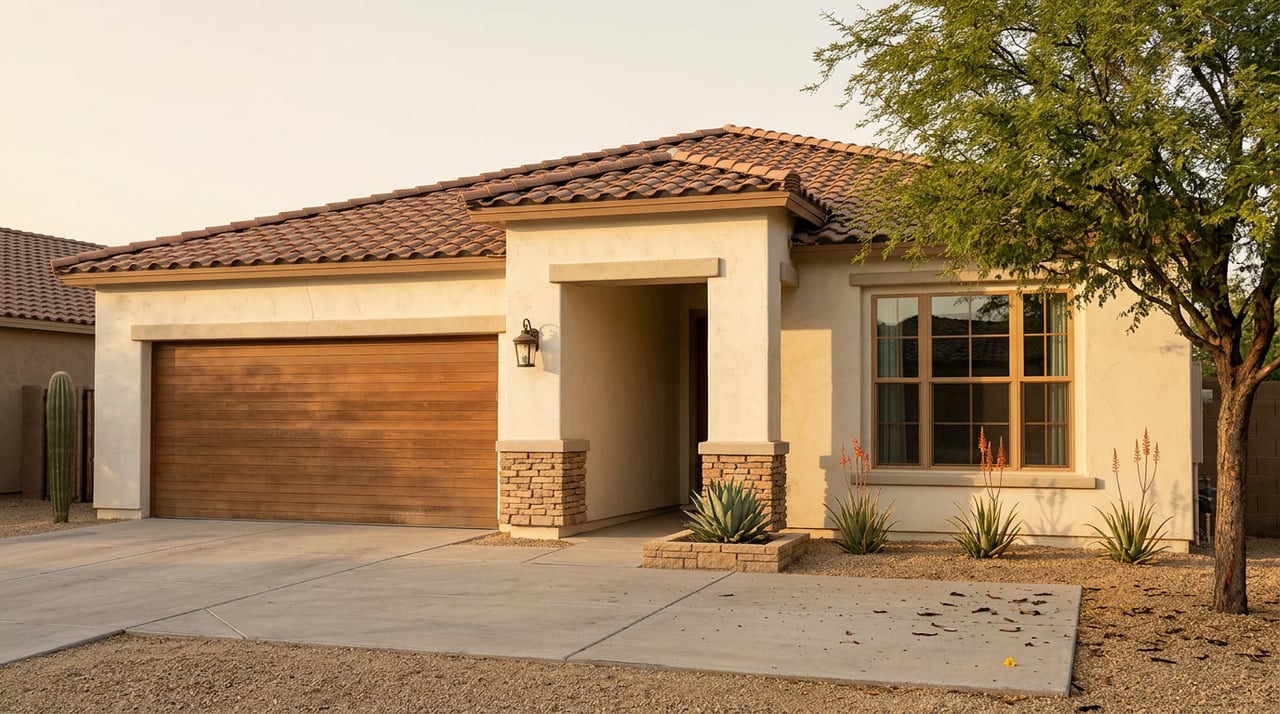
Open any portal and Maricopa looks like the clearest bargain in the Phoenix metro. The single-family median sale price sat near $345,000 in June 2026, down about 4.2 percent year over year across zip codes 85138 and 85139. Compare that against a county-blended median closer to $476,000 across Maricopa County in July 2026 and the pitch writes itself.
The pitch is also incomplete. Two mechanics inside the Maricopa new-construction market change what that median actually means for a buyer writing checks in year one, and for a seller pulling comps in year three. Neither shows up on a listing page.
The median is a price, not a payment
A median tells you what a house closed for. It says nothing about how the buyer got the payment to work, and in Maricopa right now, the how is doing most of the heavy lifting.
Builders are stacking incentive packages through rate buydown credits and closing cost contributions worth up to $50,000 on select standing inventory, competing against a 4.2-month resale supply and an upper-6 percent mortgage rate environment. That matters because a rate buydown moves money into the financing stack rather than off the sticker price. The recorded sale price stays high. The buyer's monthly payment comes down. Two houses that look identical in the county records can carry very different true costs, depending on which incentive the buyer took.
For a mid-market buyer, that distinction is the whole ballgame. A $360,000 recorded sale with a two-one buydown lives in the MLS as a $360,000 comp. A $340,000 recorded sale with no incentive lives there too. Only one of those buyers is actually paying for a $360,000 house.
Why builders picked buydowns over price cuts
This is not accidental. When a builder cuts base price, every future buyer in that community has a new, lower comp to point at, and the appraiser handling the resale down the street has a new ceiling to work under. When a builder covers rate and closing costs instead, the recorded price holds and the neighborhood's paper value holds with it.
That is why the current Maricopa lineup skews the way it does. With mortgage rates in the upper-6 percent range, builder incentives in June 2026 are skewing heavily toward rate buydown credits and closing cost contributions rather than straight price cuts, which protect appraisal comps. Using a dedicated buyer's agent at first contact with the sales office matters here, because waiving representation typically costs tens of thousands in negotiable items without saving anything off the base price.
The reader's takeaway is not that incentives are bad. They can be excellent. The takeaway is that the "median" line on a portal is measuring the recorded sale price of houses that were, in many cases, effectively discounted through financing rather than price. A buyer comparing Maricopa's $345K to another suburb's $450K is not comparing apples to apples unless they know which of those markets is subsidizing rate and which is cutting price.
The line item most out-of-state buyers miss
The second thing the median cannot see is what shows up on the monthly statement after closing. Maricopa's newer master-planned communities carry two separate community charges, and only one of them is obvious.
All new construction in Maricopa carries master HOA fees ranging from about $48 per month in Homestead to $258 per quarter in The Villages. Some communities also carry Community Facilities District, or CFD, special assessments on top of HOA fees, and the property disclosure needs to be read carefully.
A CFD is a public financing tool that lets a district issue bonds to pay for infrastructure like roads, water, and sewer inside a new development. The bonds get repaid through an assessment on the property tax bill of every parcel inside the district. It is legitimate and disclosed, and it does not appear anywhere in a sticker price. Two houses in Maricopa that list at the same price can carry meaningfully different long-term carrying costs based purely on whether one sits inside a CFD and the other does not.
That is the friction that catches relocation buyers, particularly buyers coming from Chicago, Seattle, and Los Angeles, which Redfin's late-2025 migration data flagged as the three metros searching to move into Maricopa most heavily. Buyers from outside Arizona often model taxes as a flat percentage of purchase price and get surprised the first time the escrow statement arrives with a CFD line under it.
A practical read on the current subdivision map:
- Rancho Mirage and The Estates at Rancho Mirage are where the higher end of the price-per-square-foot range sits, driven by newer K. Hovnanian, Meritage, and DRB releases.
- Sorrento, Elena Trails, and Moonlight are active D.R. Horton communities, alongside Gehan Homes work in Rancho El Dorado, Lennar in Anderson Farms, and Pulte in El Rancho Santa Rosa.
- Amarillo Creek is a newer Ashton Woods master plan, and Palomino Ranch is pre-selling in phases.
The right question at a sales office is not "what does the house cost." It is "what is the base price, what is the effective price after incentives, what is the HOA, and is this parcel inside a CFD." Four numbers, one decision.
The commute variable that is changing the math
Maricopa's affordability case has always hinged on commute tolerance. Two developments are quietly redrawing that math.
The first is employer demand. The Lucid Motors expansion is the single most important employer story for the Maricopa housing market over the next five years. Lucid operates AMP-1 in Casa Grande with roughly 3,000 full-time employees as of late 2025 and has expanded into a second Coolidge manufacturing plant acquired from Nikola, plus a Phoenix hub facility, with a new midsize Lucid SUV launching in 2026 from the Arizona plants and the labor draw pulling directly from Maricopa, Casa Grande, and Coolidge housing inventory. Buyers who assume Maricopa is a Phoenix bedroom community are pricing off the wrong commute. A growing share of local demand is not commuting north at all.
The second is road capacity. SR-347 widening and the planned SR-347 and I-10 interchange improvements are actively under design, which would shorten the Phoenix metro commute significantly when delivered. That is a future value input, not a today input, and it is the kind of thing a portal median cannot price in. A house bought in 2026 will be resold into a commute that likely takes less time than the current one.
Neither of these changes the $345,000 median. Both change what the $345,000 house is actually worth to a household deciding between Maricopa and, say, Queen Creek or San Tan Valley.
Reading the rest of the market against the median
The context around the number matters too. The average list-to-sold ratio held at 98.7 percent in the most recent read, with Maricopa closing 91 homes in May versus 88 in April, a modest pickup lining up with the broader Phoenix metro pattern of accepted contracts running ahead of last year. At the county level, active listings stood at roughly 15,011 with a 3.0-month supply at the current sales pace, and the July 2026 median sale price came in at $454,990, up 1.1 percent year over year.
Read together, the picture is a market that is not falling and is not spiking. It is a market where the headline price is doing less of the work than usual, and the financing stack, the CFD map, and the employer story are doing more. A buyer who reads only the median will underprice the friction. A seller who prices only against the median will misjudge what the comps are actually saying.
Before you sign, ask these four questions
- Base price vs. effective price. What does this home list for, and what does it net to after builder incentives are applied to rate, closing costs, and design center?
- Financing structure. Is the incentive a permanent rate buydown, a temporary two-one buydown, or a closing cost credit? Each has a different year-three cost.
- CFD status. Is this parcel inside a Community Facilities District, and if so, what is the current annual assessment and when does the bond mature?
- HOA scope. What does the master HOA cover, and are there sub-association fees on top of it?
Those four questions turn a median into a monthly payment you can actually plan around.
FAQ
Does a rate buydown transfer if I sell in three years? No. A builder-funded buydown attaches to the original loan, not the property. A future buyer will finance at whatever rates are available then. That is why the buydown protects the comp for the neighborhood but not the payment for the next owner.
Are CFD assessments negotiable? The assessment itself is set by the district and is not negotiable at the closing table. What can be negotiated is who pays any prorated portion at closing and how the assessment is disclosed. Reading the public report before signing is the checkpoint.
Is Maricopa new construction still cheaper than resale? Sometimes, once incentives are counted. Entry-level new construction has been pricing near $235K with builder rate buydowns, against long-term rents in the $1,400 to $2,200 range, which is why investors keep circling the market. A resale without incentives may show a lower sticker but a higher effective monthly cost.
If you are weighing Maricopa against another Phoenix-metro suburb and want a straight read on what the number in front of you actually means, Eddie Villalobos and the team work these subdivisions every week. Start your property search, bring your questions, and we will walk the math with you in English or Spanish.